A good fit has to describe a real sample.
At HRL, I rebuilt the ellipsometry measurement plan supporting the qubit program. The process involved complex stacks of compound semiconductors, dielectrics, and metals, with individual films ranging from a few nanometers to hundreds of nanometers. During back-end-of-line processing, I needed to measure stacks of six layers or more, sometimes with the same material appearing several times, and often including optically absorbing materials that degrade the signal from underlying materials.
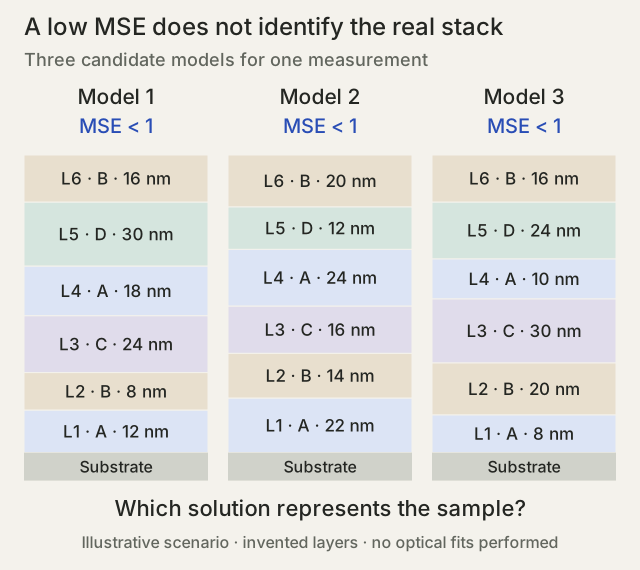
Ellipsometry measures the change in polarization of reflected light. Extracting thickness and optical properties requires a model of the sample. In a complex stack, several combinations of adjustable parameters can agree closely with the optical measurement. A low fitting error (MSE) describes that agreement; it does not establish which physical structure is actually present.
The existing approach attempted to fit the thickness and optical parameters of every layer, with only loose thickness constraints. Discussions with integration staff revealed that underconstrained fits had led to operator-dependent result selection. Improving the measurement required rebuilding its physical foundation and workflow.
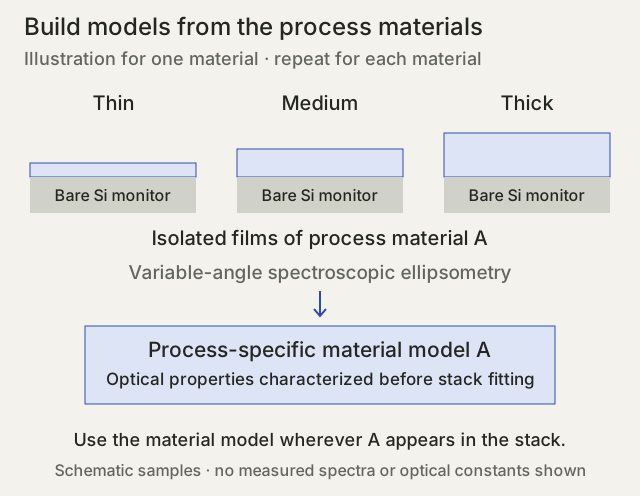
Establish what the materials actually are.
With the program’s approval, I worked with the integration team to obtain each stack material deposited separately on bare silicon monitor wafers. For some materials, we prepared several film thicknesses. This gave me samples whose simpler structure made it possible to characterize the individual process materials before combining them into complex stacks.
Using variable-angle spectroscopic ellipsometry, I developed layer models for HRL’s own deposited materials rather than relying on vendor-provided material libraries. Those models became the basis for the multilayer recipes at different steps of the process flow.
Before asking the model to determine precise thicknesses, I established which material properties and prior layer measurements it could rely on.
Carry measured knowledge forward.
I designed the process-step models to be linked. An early model measured the thickness and refractive index of one or two films. The next model read those results, held them fixed, and fitted only the next layer on top. Later models could read the preceding results in the same way.
Each new measurement therefore addressed a smaller set of unknowns. Repeated materials still had distinct layer identities and thickness histories: knowing the material did not mean that all its layers shared one thickness. The measurement plan carried those earlier results into the appropriate model for the next process step.
Conceptual example / Linked process-step models
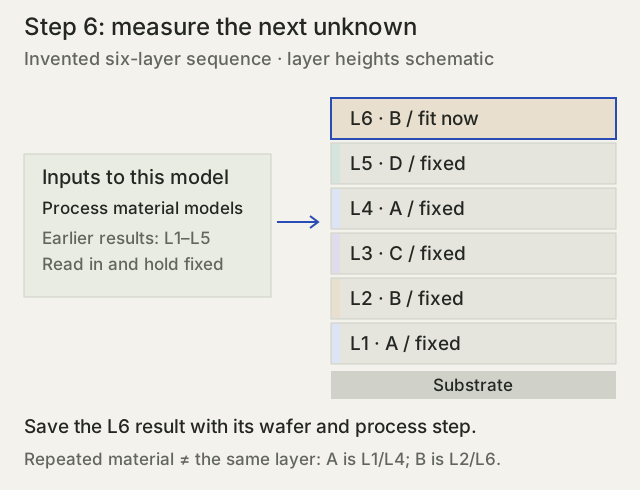
Step 6: read the results for L1–L5 and hold them fixed. Fit L6, a new layer of material B, using its characterized material model. L2 is also material B, but its earlier measurement stays fixed.
Make the result usable in production.
This strategy significantly improved measurement repeatability and reduced operator variation. The linked workflow was compatible with automatic ingestion into the production database, enabling product-level statistical process control on qubit wafers. HRL’s CEO recognized the work as a major improvement to the program’s process capabilities.
The deliverable included the material characterization, the models for successive process steps, and a measurement plan that other users could execute consistently. My broader metrology work also covered reflectometry, calibration and qualification methods, and Python and SQL automation for visualization, reporting, and process feedback.
Earlier foundations: material development at Intel.
At Intel, I developed spectroscopic ellipsometry models for novel semiconductor materials on 300 mm wafers. They supported mapping of film thickness, optical constants, and optical band gap, and were transferred to the inline metrology team for process control.
That work grew out of my responsibilities for industrial CVD/ALD tool ownership and novel BEOL film development, including tool bring-up, qualification, and process stabilization. Across this modeling work, individual-layer measurements, structured design-of-experiments samples, and secondary characterization helped check whether a good mathematical fit represented a useful physical model.