A measurement built around the experiment.
During my doctoral research in the Palmstrøm group, I grew epitaxial magnetic thin films and studied how their structure and interfaces affected their properties. I designed and built a custom magneto-optic Kerr effect (MOKE) magnetometer to characterize those films in an ultra-high-vacuum environment.
The measurement uses changes in the polarization of reflected light to probe the sample’s magnetization. Making that useful required a complete instrument: an optical path, magnetic-field control, signal detection, calibration, and software that could coordinate the experiment.
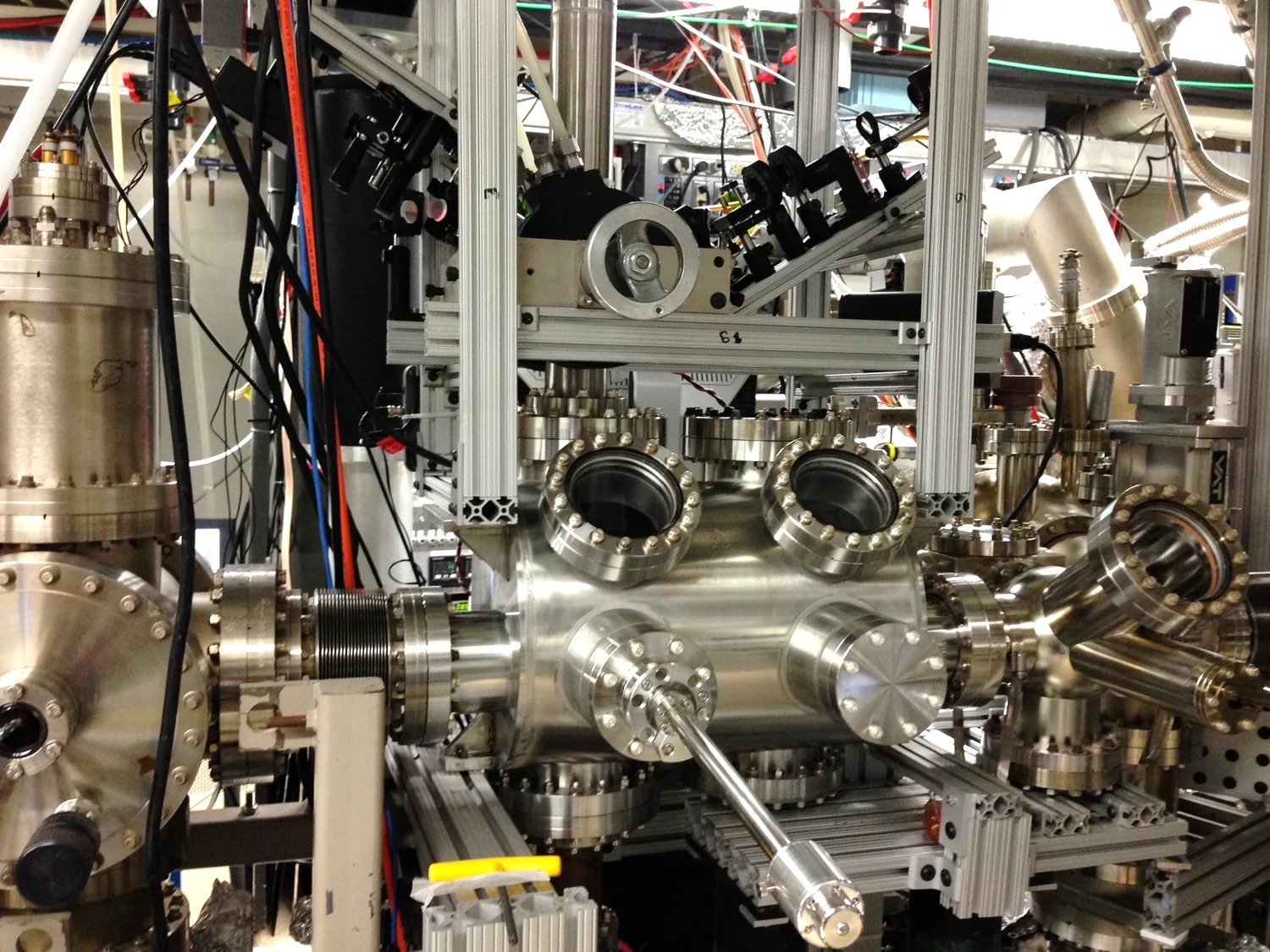
Hardware and software, developed together.
I built the system around a HeNe laser and polarization optics, with a balanced photodetector and a controllable magnetic field. LabVIEW handled instrument control and acquisition; MATLAB tools and graphical interfaces supported the subsequent analysis.
The control interface brought field settings, sampling parameters, and live measurement plots into the same workflow. It let the experimenter see what the instrument was doing while the measurement was underway.
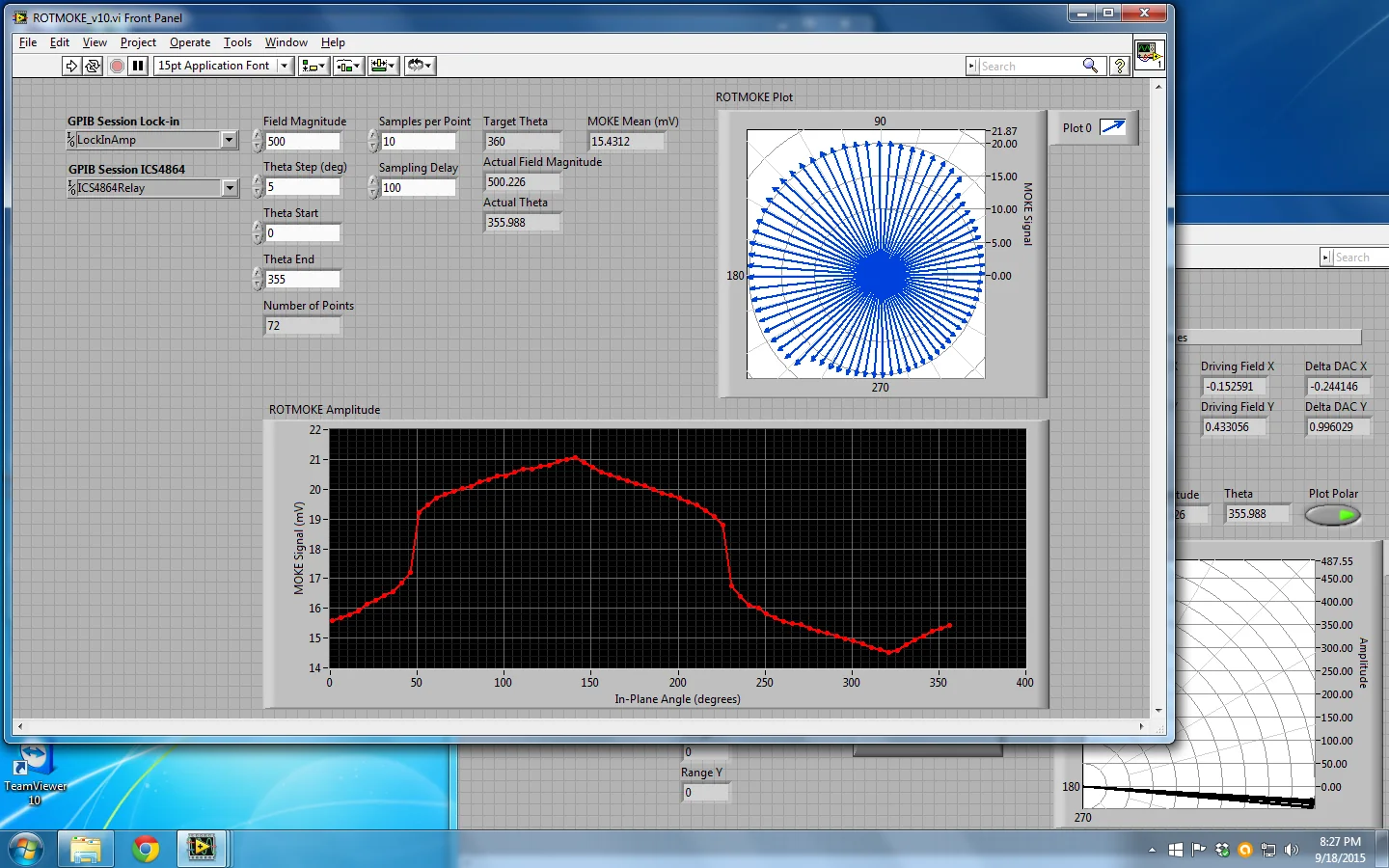
Connecting a signal to material behavior.
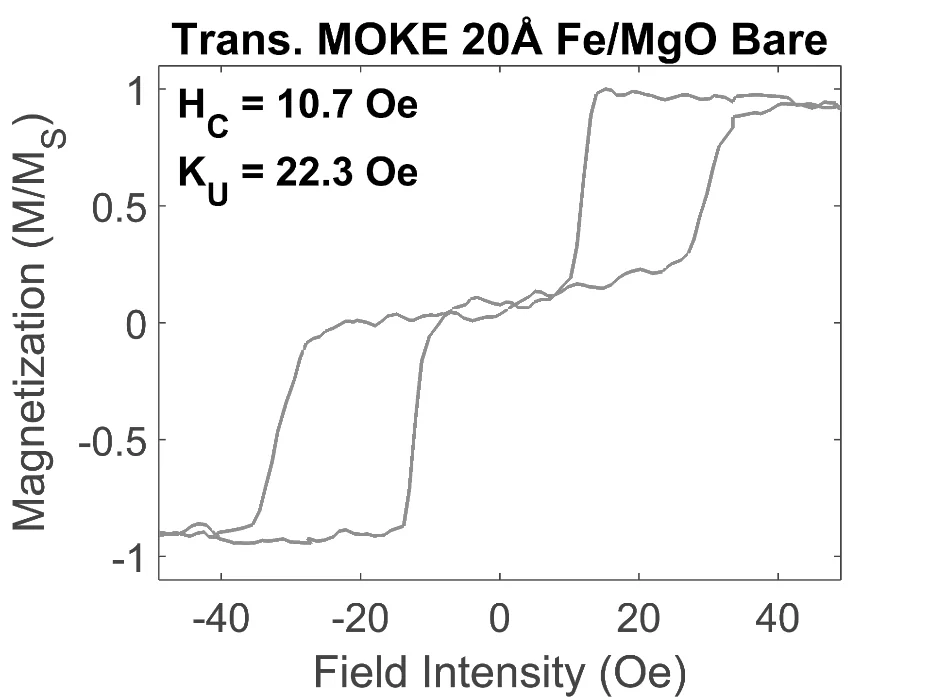
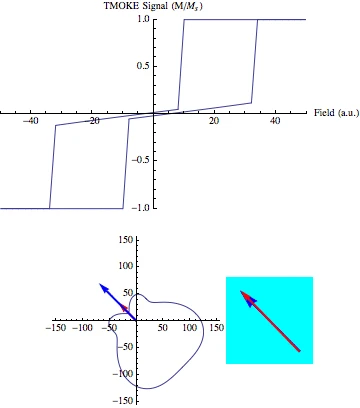
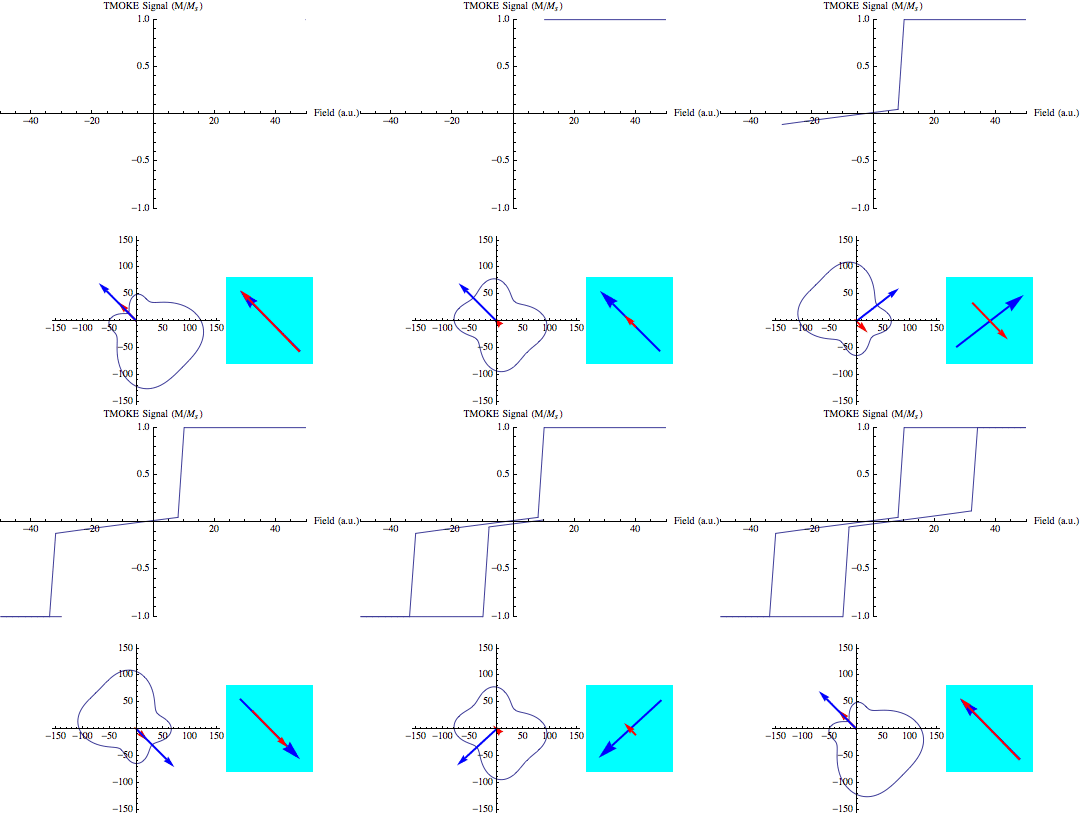
I used the system to extract magnetic hysteresis loops from films less than 5 nm thick. Analysis of the measurements yielded magnetic anisotropy constants. I fed those experimentally determined constants into a Stoner–Wohlfarth simulation of a magnetic domain with in-plane uniaxial anisotropy. The simulation reproduced the measured hysteresis curve, closing the loop between experiment and interpretation.
MOKE was used alongside ex-situ magnetic and electrical measurements to guide the development of thin films with perpendicular magnetic anisotropy. The measurements were part of a broader cycle of film growth, characterization, modeling, and refinement.
Why this work still matters to me.
Building the instrument made the dependencies between hardware, data acquisition, and interpretation tangible. A useful analysis tool needs to carry that understanding forward: its inputs, controls, and outputs should make sense in the context of the actual measurement.
A description of the technique and instrument is in section 2.3 of my doctoral dissertation (PDF page 61 of 217).